Picture a lower third for a speaker. In a traditional workflow, it may begin in a design app, move through animation software, become a video file, and finally land in the playback system. It can look beautiful. It can also be strangely fragile when the name changes ten minutes before doors open.
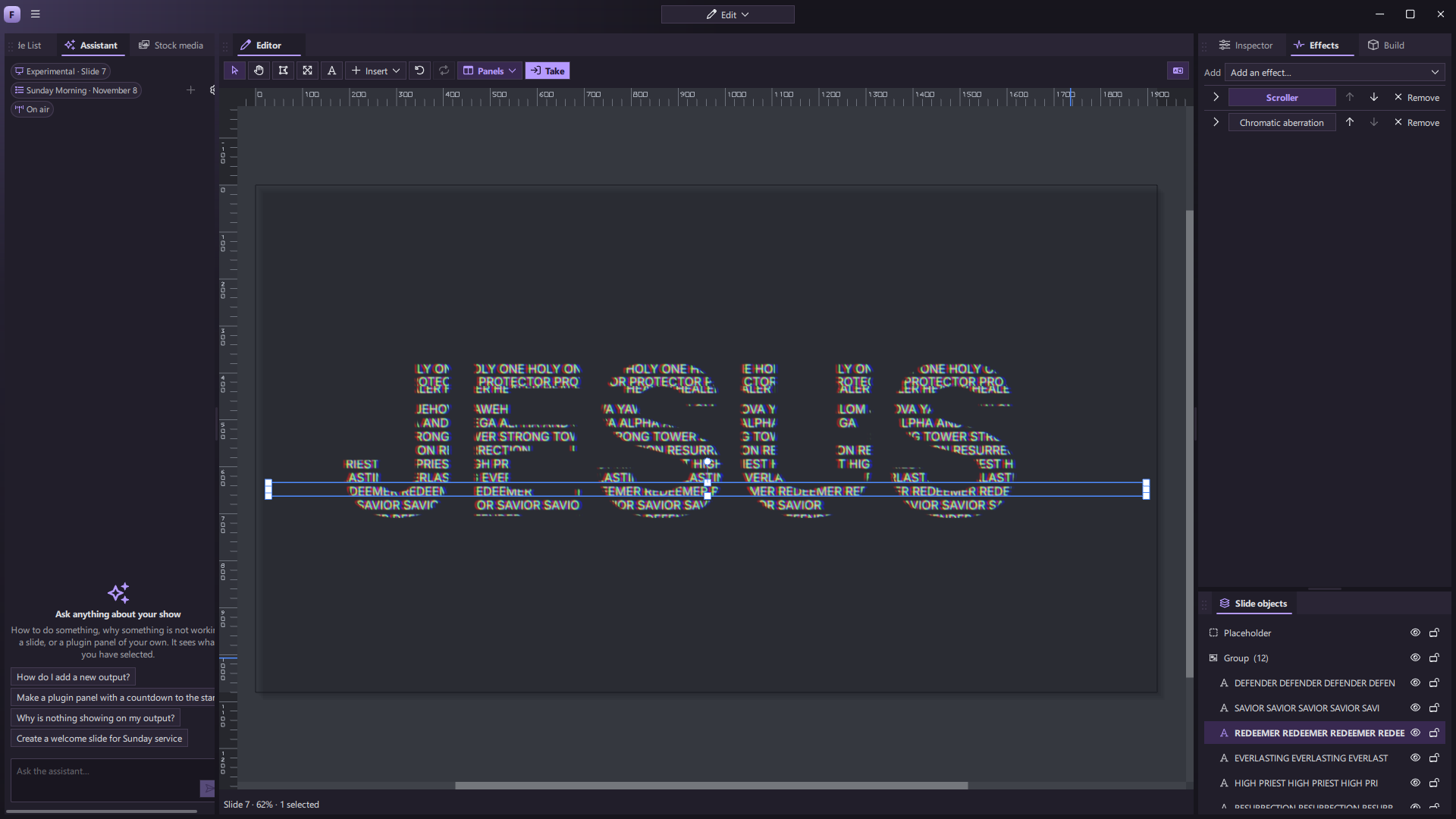
ForShow takes a different route: the design remains a living slide.
Edit the thing that goes on screen
The text, shapes, images, video, masks, gradients, and effects stay editable. A title can build in, move gently while it is visible, and leave with its own motion. A lyric can type onto a procedural background. A countdown can sit over a live camera. You can change the words or the colors without rebuilding a movie.
The editor and program use the same scene model underneath. That makes it possible to design with a close sense of what will appear on screen. Outputs can still make deliberate choices of their own—language, theme, layers, stage layout—so the final picture is tailored to its destination.
Motion is a set of choices, not a single preset
ForShow’s effect catalog ranges from familiar shadows, blur, color, and film texture to repeaters, kaleidoscopes, particle motion, and procedural surfaces. Builds decide when an element arrives, waits for a click, or leaves. Loops keep it alive. Keyframes let a designer reach past the preset and tune the movement directly.
The combination matters more than any one effect. A simple line of text can have a different rhythm when it reveals one word at a time, echoes into a trail, or follows a beat. A shape becomes a wall of lights when repeated across a grid. A quiet background becomes a visual identity with the right palette and motion.
No render queue between idea and cue
For live work, the time between making a change and seeing the result matters. We want a designer to try an idea, take it to preview, adjust it, and move on. Existing video files still belong in the workflow, and a heavy slide can be exported to video when that is the practical choice. But the creative starting point should be editable by default.
We are building a growing library of motion designs around this engine. Our launch goal is more than 1,000 free editable presets—lyrics, lower thirds, countdowns, titles, and backgrounds—but the final catalog will be confirmed at release. The interesting promise is not just the number. It is that every design can be taken apart and made yours.
The engine is one part of that. The other is a workspace that lets you use the result in the room, on stage, and online without leaving the show.