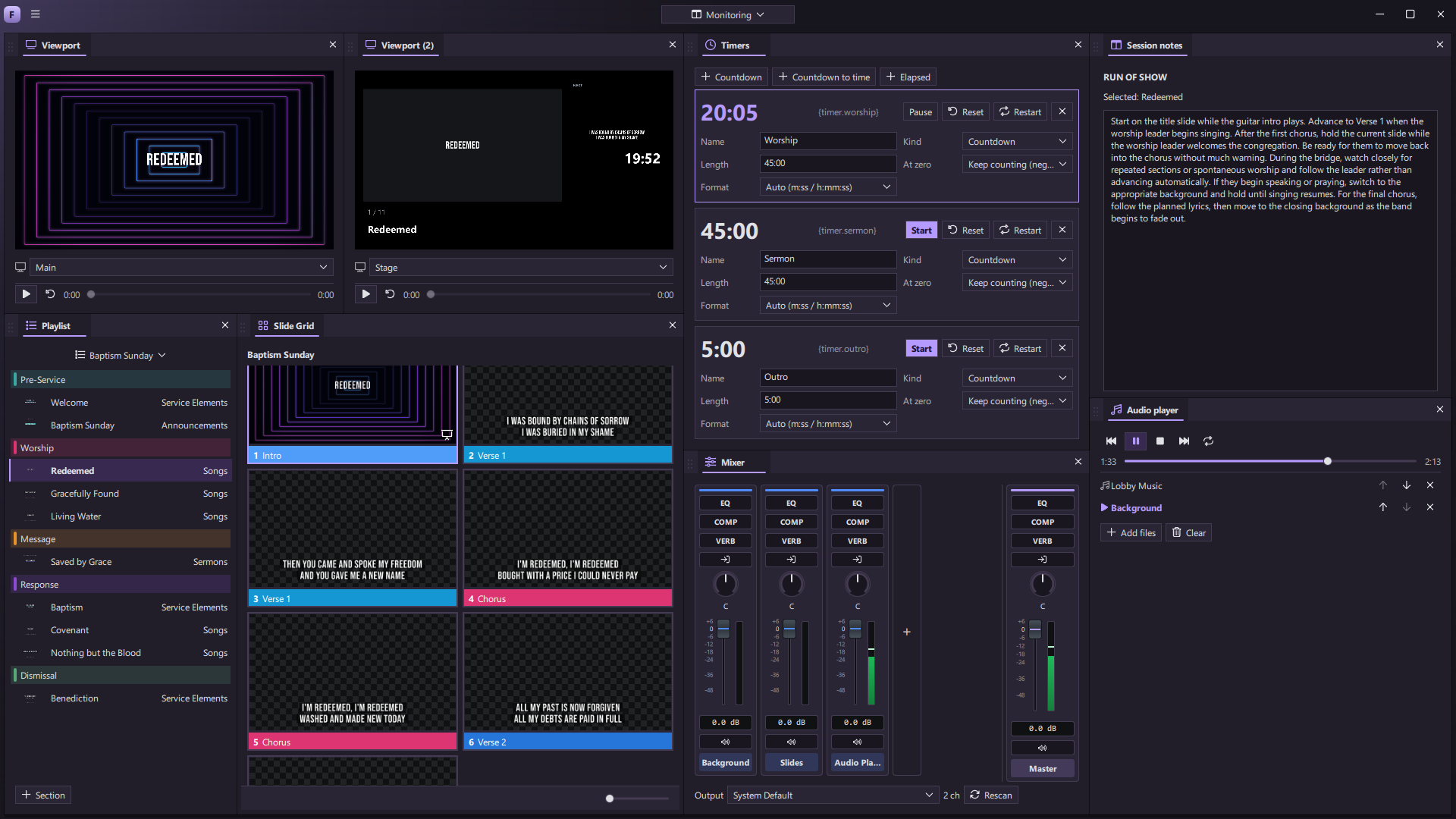
The same moment looks different depending on where you stand.
The audience in the room may need a lyric over a full-screen motion backdrop. The band may need the current and next line, a clock, and a message from the booth. The online viewer may need a camera, a lower third, and a clean feed that omits the background video.
Trying to make one picture serve all three is a compromise. Making three entirely separate shows is a burden. ForShow is being built around the space between those extremes.
One cue, different compositions
An output can choose which layers to include and how the picture is treated. One screen can carry the full room composition, another a simplified look, and a stage display its own template. A Viewport can watch each one, so the operator knows what people are actually seeing.
This also creates useful creative choices. A slide theme can establish the room’s visual language, while a stream output uses an alternate treatment. A bilingual event can put one language in the room and another online—or show two together. The document stays the same; the output makes the presentation choice.
The stage is its own audience
Stage displays are often treated as an afterthought. We think they deserve their own design. The people presenting need confidence, not decoration: what is up, what is next, how much time remains, and whether the booth has a message. ForShow’s starting layouts cover those cases, and the same editor can shape them for a specific room.
Visuals and sources meet at the right layer
Background media can stay in place while slides change. A camera can sit under lyrics. A clip can have its own playback, trim, color, and sound settings. The operator can keep a bank of media actions ready without turning every background change into a new presentation.
This is why “every output its own picture” is more than a routing feature. It lets a team think about the experience of each audience without multiplying every edit. The same show can be more coherent, and each screen more useful.
We are testing output and hardware options across Windows, macOS, and Linux as we prepare for release. The idea guiding that work is simple: one production, with a considered view for every audience.